Astronomy: The night was a bust, well almost!

After two months, there was a clear night in the Pacific NorthWest. Naturally, I decided to set up my telescope and get some pictures. I wanted to capture some real data to process and publish so did not tinker with my setup. Since it is galaxy season right now and between the mirrorless and CCD camera, the CCD set up was tried and tested, so I decided to use it. After putting my son to sleep, at around 8pm, I set up my camera, polar aligned it and got the imaging camera in focus. Problem started when I was looking to get my guide camera in focus. The camera wasn’t taking a picture and returning this error: [ERROR] GetQHYCCDSingleFrame error (-1)

I tried rebooting my Raspberry Pi and switching the USB ports but still the same error. I had recalled that earlier i had to download the latest SDK to make my QHY camera work. I tried that as well but with no luck. At that point I decided that instead of trying to debug the issue, I would rather capture some data. Without autoguiding, I couldn’t expect to get pinpoint stars with more than 30 second exposure but that would mean I wouldn’t get any sort of details of the galaxy arms. Even so, I just wanted to be able to capture some deep sky object. The target was M51 (Whirlpool Galaxy) and plate solving (which I had a bit of trouble getting remote solver to get going) placed smack in the middle of my frame. I started shooting 30 second subs and luckily there was no trailing. I could have bumped up the sub duration but I did not want to try it then. I took around 60 subs plate solving every 10 or so subs to make sure the object was in the center of my frame. I could have continued taking more pictures but I prefer at least 3 minute subs so checked the weather for the following night – “mostly clear” and decided that I will debug the problem during the day and set up the following night and hopefully get some useful data. I took around 10 darks and called it a night around midnight. I’m still figuring out the issue with the QHY camera and will write about it in a subsequent post but for now, here is what I captured:
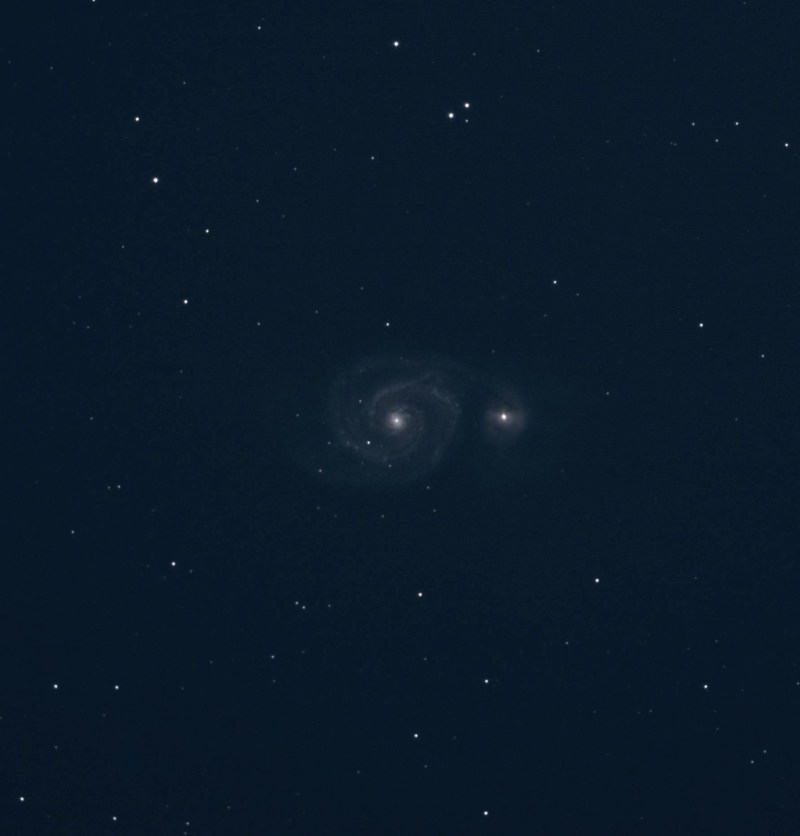
M51 Whirlpool Galaxy. 60 30 second subs 10 30 second darks and no auto guiding.

This is a stack of 60 30 second subs and 10 30 second darks with just some stretching and no post processing. I still have a long way to go for getting a great print worthy astrophotograph but I think the night was not a total bust. One thing astrophotography will teach you is to be patient :). I have been at it for more than a year now but don’t think I have one photography that I can call great. I have, however, learnt a whole lot in this past one year and hoping that my efforts at documenting my journey will be helpful to folks who are just taking this hobby up.

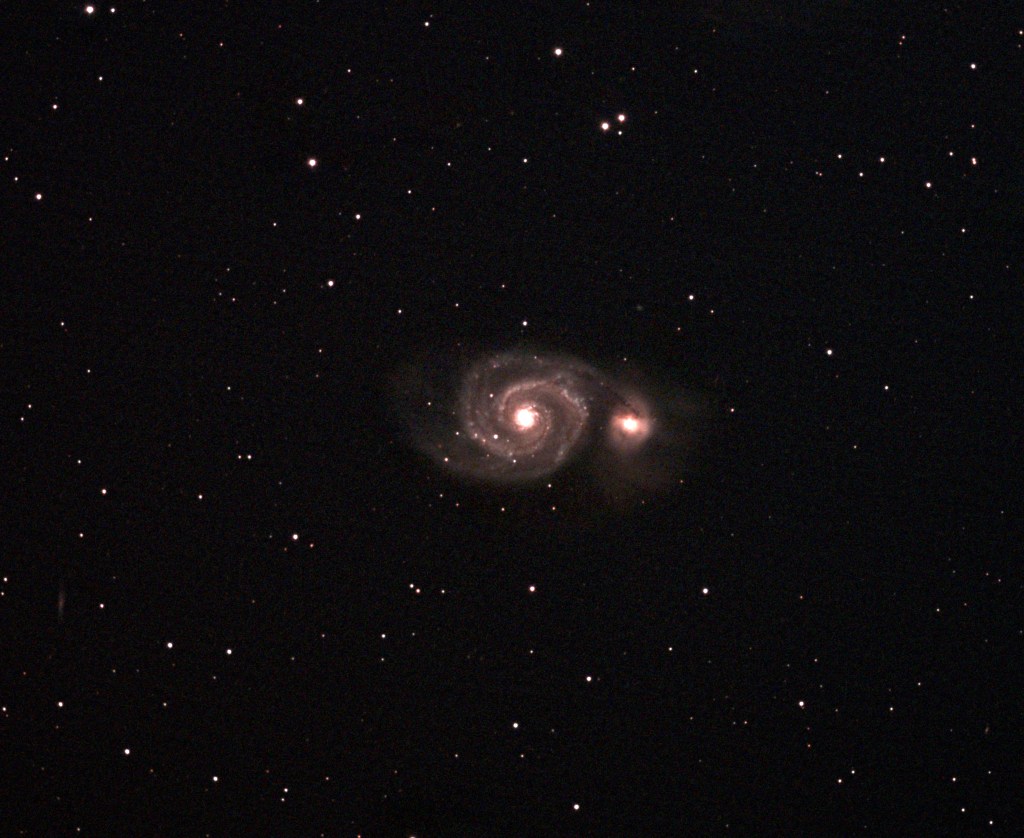
[Edit]: Here is a post processed version of the image. After the initial stretching, I tried to get rid of some light pollution. I still have a long way to go in terms of learning how to post process but for such a short integration time, I don’t think the image is half as bad. What do you think?
Astronomy: The red planet

While visual astronomy provides its own sense of fulfillment, capturing those amazing night sky visuals on a camera provides one with another kind of thrill. However, capturing photographs of the night sky is a whole another ball game and a bunch of investment in time and of course money 🙂

I hadn’t been spending too much time on astronomy/astrophotography and wanted to get back into it so I recently spent a whole lot of moolah in new gear. There were several reasons for my lack of time investment in astronomy/astrophotography : 1) my first telescope, an 8 inch Newtonian, was big and bulky for a quick set up 2) I was still getting my head around polar alignment meaning a whole lot of time spent just in getting the telescope set up 3) Newtonian’s require a lot of upkeep including collimation adding to the set up time 4) Pacific northwest weather did not give many opportunities for clear night skies 5) Life.

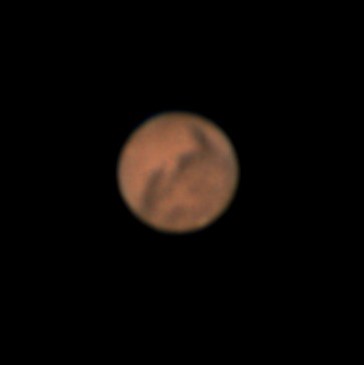
Mars taken through 4 inch refractor at opposition

So, the first piece of gear I bought is the Explore Scientific 4 inch refractor telescope. While the scope is half the aperture size of my Newtonian, it is much lighter and bulky so very easy to carry and handle. The second piece was a planetary camera QHY462c and the third one was a 5x barlow. I rushed to purchase the camera and barlow specifically to capture Mars, which was soon going to be in opposition. Armed with the new gear, I set up in my drive way. Unfortunately, the seeing wasn’t as great on the two nights that I set up so extracting good frames was a bit challenge. With the PNW weather, you don’t get many nights in winter where the sky is clear. So those were the only two days where I got a good view of Mars from my drive way. I was able to capture the above image. I think it is not half as bad for a first planetary photograph!

While I am happy I was able to capture this picture, I think for planetary photography, my 8 inch Newtonian is better suited. Over the past several months, I have learnt a lot and I think am now better equipped to take my Newtonian out and quickly setup whenever I need to do planetary imaging. However, that would have to wait for a clear PNW night and planets showing up in the eastern sky to be visible from my driveway.

Astronomy: Polar alignment

As every newbie amateur astronomer might have at some point struggled with polar alignment, so did I. In this post, I’d like to share an aid that I have started using that has helped me reduce my frustration and time required for setting up and aligning my telescope. Just FYI, I have spent many a wasteful dollar to get better at astro photography. Partly because I like to do things on my own and partly because I rush to try something to see if it works. I had initially bought the polar alignment scope from Orion. While useful, this aid requires that the scope itself is aligned. In the sense, if you place the scope on the mount and rotate the mount in the RA axis, the position of cross hairs should not move. I found that the scope I bought did not have this aligned. It required a lot of fine tuning to make sure that was the case (I don’t want to get into the details of that on this post). I used this for a few times but was not convinced that I was getting polar alignment right.

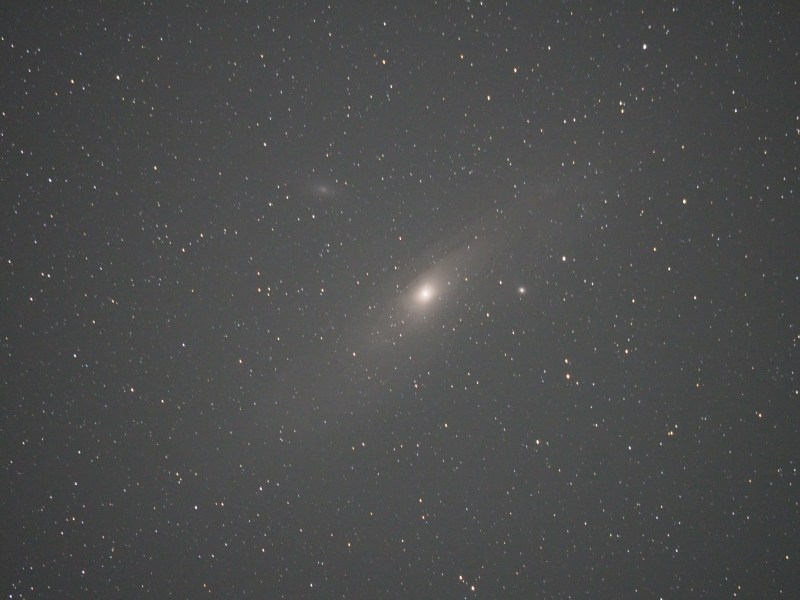
I researched a bit and and learnt about QHYCCD pole master. This device makes polar alignment a breeze. Please note that this is not very useful if you are a visual observer and do not carry a laptop with you for your astronomy sessions. This device gets you amazing polar alignment in the less than 20 minutes. Recently, I purchased a APO triplet refractor for getting into astro-photography and I before that I arrived, I wanted to test out my pole master given I was having issues with it when I tried it out last time around. I just took my camera this time to take some photos of Andromeda Galaxy with a tracking mount and pole master aligned tripod. I took few photos and one with six minute exposure. Given the warm night, the seeing was kind of okay. I will let the photo speak to the quality of polar alignment. This is an unprocessed single six minute exposure of the Andromeda Galaxy:

OLYMPUS DIGITAL CAMERA

The slight trailing you see there can be attributed to the seeing and not polar alignment. I can say that with confidence because I saw this trailing even for a 30 second exposure photo. I had to squeeze this session in between my new born’s sleeping hours so wasn’t able to spend extended hours outside. While wrapping up my session, disaster struck – I dropped by telescope tripod mount. The stepper motor for RA axis got dislodged. I figured it out while trying to test out telescope control using Stellarium. I put the stepper motor back in place but haven’t checked if everything is working fine. I’ll need to check that when I get a chance again.

Astronomy: New telescope weirdness

One of challenges for me making progress in getting better at astronomy and astro- photography apart from the fact that I live in Pacific Northwest (PNW) which has way too many cloudy nights, is the fact that back when I bought the telescope, I bought a 8 inch Newtonian which was way too bulky and complex for a newbie. While, I have gotten better and now no longer consider myself a newbie, the bulky equipment was still a challenge setting up, aligning, and collimating on cold PNW nights before actually getting into visual astronomy or astro-photography. In order to make things easier for me, I recently purchased a refractor telescope. It’s a 102mm triplet which corrects for any chromatic aberrations. It’s less than half the length and weight of my Newtonian reflector.

4 inch triplet refractor telescope from Explore Scientific

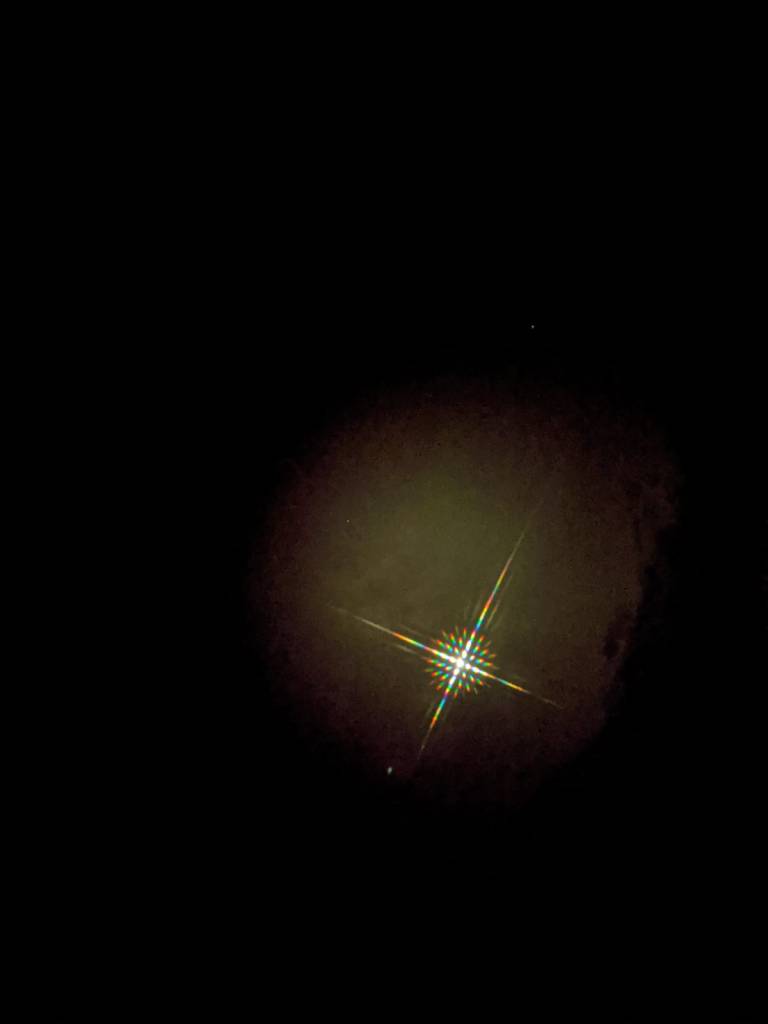
After I got it last week, I was eager to test it out and do visual observing to see how it compares to my old telescope. Since I have a 4.5 month old at home, it’s hard for me to be away for several hours at night so I decided to set it up in one of the rooms with a view of the eastern sky. In the last few weeks Mars is prominently visible in the Eastern sky which seemed like a pretty good target to view. I also got a QHY CCD guide scope and planetary imaging camera that I was interested in testing out. As the night fell, I quickly set up the telescope and tried to view Mars through the 25mm eyepiece. The telescope comes with 2 spacers to be able to adjust the focal length. To get a sharp image, I had to use one of the spacers. When I viewed Mars through it, the planet looked weird. It was as if there was a Bahtinov mask placed on the telescope. See below the picture that I took from my smartphone camera placed in front of the eyepiece.

Diffraction Pattern: Image of Mars through a window with screen

I was concerned and reached out to the customer service to get this resolved. The agent, who was very helpful, thought I might need to collimation to get the lenses aligned. I was very concerned with this given what I read online about collimating a triplet refractor. He assured me that this was not a monumental task if I am familiar with collimating a Newtonian, which I was. I was getting mentally prepared to do collimation but were still exchanging emails about the problem. After some back and forth discussion and exchange of pictures of my set up and telescope, the agent suggested that maybe I should try to take the telescope outside given I was viewing through my window and screen. I thought it might not help but I said I will. I did some online research on effects of window and screen on telescope images. Turns out that temperature differences and screen can have big impact on what we see through the telescope. The screens actually cause a diffraction pattern which result in the image that you see above . Excited that this might be the reason for what I was seeing, I took the telescope out that same night and voila: crystal-clear views of Jupiter and Saturn.

I profusely apologized to the kind agent for sending him on a wild goose chase. Having a recent Master’s in Physics I should have figured that the screen at that distance from the source of light and the telescope was small enough to cause diffraction pattern. However, I was so focused on there being some misalignment on my telescope that I did not even think about it. While classroom learning as all well and good, as they say, experience is the best teacher.

Astronomy: Comet C/2020 F3 (NEOWISE)

This year we have a visitor from outer space that is currently on its outward journey from our solar system. It’s the comet NEOWISE with a orbital period of 6700 years, truly a once in a lifetime opportunity for us to enjoy this rare celestial phenomenon. While a comet is nothing but a space rock made of ice and dust, the dramatic tails that these celestial bodies have make for a visual spectacle that is only second to total solar eclipses. The thing that puts them above a solar eclipse, in my view, is the rarity with which these occur.

I have been lucky to see more than one comet in my lifetime. This is the third comet that I had the opportunity to see and the first to actually photograph! The first ever comet I saw was Hale Bopp in 1998 back in India. I had been fascinated by the cosmos and its wonders from a very young age. When I read the news of this amazing celestial visitor, I quietly went up to the terrace of my apartment one night and marveled at its beauty. Despite the light pollution of Hyderabad, the comet was clearly visible in the night sky. Unfortunately, back then, we did not own a camera so I could not capture it in photograph but it was truly a sight to see.

The second comet that I had the opportunity to see was C/2011 L4 (panSTARRS) in 2013. While i missed seeing the comet when it was bright enough to be visible to the naked eye, I got to see it through my telescope during the twilight in Orange county, California. Unfortunately, I wasn’t able to take a picture of it.

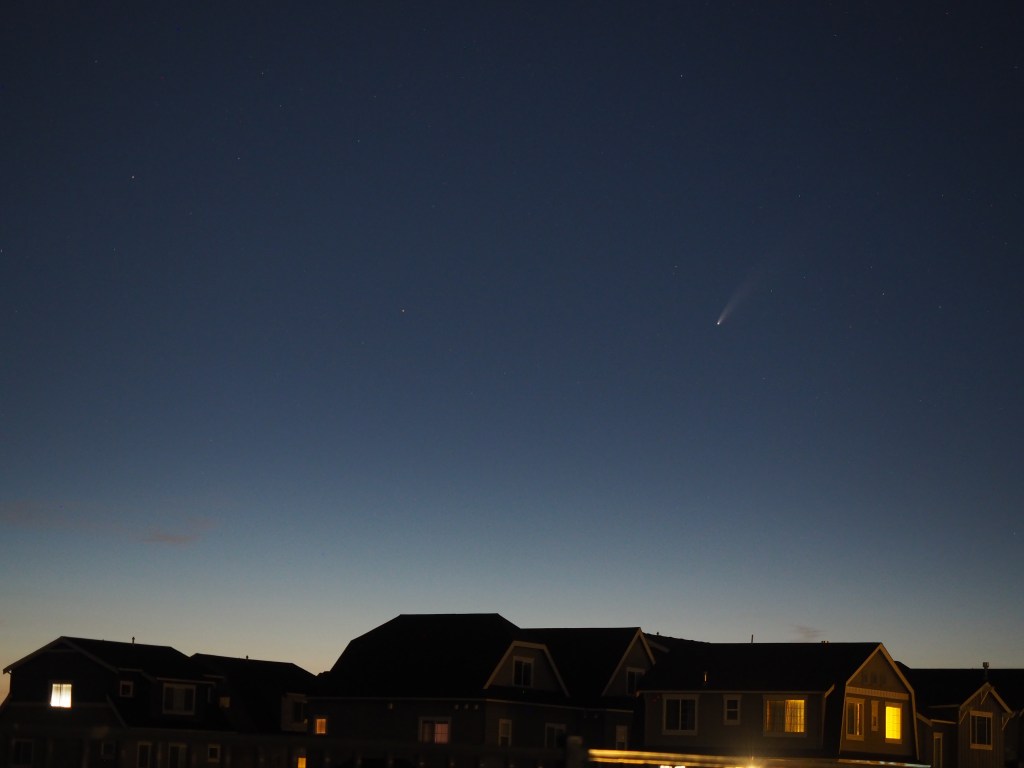
Comet NEOWISE though, offered a spectacular show. While not of the order of comet Hale Bopp (or from what I heard, Halley’s comet), it was still a sight to see. While I still haven’t captured a good quality image, I did get a chance to get some quick snaps of the comet. Here is a picture that I grabbed last week.

Comet NEOWISE in all its glory

I am hoping to go back out this weekend to capture some better images of the comet. This weekend is my last chance to see this celestial visitor and capture images before it makes it way back in our cosmic neighborhood 6700 years later. Not sure if the human race will survive till then given how we seem to act against our own self interest but hoping we realize sooner rather than later that earth is the only home we got and we are all one people. I would like to leave you with a famous quote (more a paragraph) from Carl Sagan reminding us of our place in the cosmos:

Look again at that dot. That’s here. That’s home. That’s us. On it everyone you love, everyone you know, everyone you ever heard of, every human being who ever was, lived out their lives. The aggregate of our joy and suffering, thousands of confident religions, ideologies, and economic doctrines, every hunter and forager, every hero and coward, every creator and destroyer of civilization, every king and peasant, every young couple in love, every mother and father, hopeful child, inventor and explorer, every teacher of morals, every corrupt politician, every “superstar,” every “supreme leader,” every saint and sinner in the history of our species lived there-on a mote of dust suspended in a sunbeam.

The Earth is a very small stage in a vast cosmic arena. Think of the endless cruelties visited by the inhabitants of one corner of this pixel on the scarcely distinguishable inhabitants of some other corner, how frequent their misunderstandings, how eager they are to kill one another, how fervent their hatreds. Think of the rivers of blood spilled by all those generals and emperors so that, in glory and triumph, they could become the momentary masters of a fraction of a dot.

Our posturings, our imagined self-importance, the delusion that we have some privileged position in the Universe, are challenged by this point of pale light. Our planet is a lonely speck in the great enveloping cosmic dark. In our obscurity, in all this vastness, there is no hint that help will come from elsewhere to save us from ourselves.

The Earth is the only world known so far to harbor life. There is nowhere else, at least in the near future, to which our species could migrate. Visit, yes. Settle, not yet. Like it or not, for the moment the Earth is where we make our stand.

It has been said that astronomy is a humbling and character-building experience. There is perhaps no better demonstration of the folly of human conceits than this distant image of our tiny world. To me, it underscores our responsibility to deal more kindly with one another, and to preserve and cherish the pale blue dot, the only home we’ve ever known”