Private Pilot: Lessons Learned

Since the end of October, I had been flying with my instructor to stay proficient in my flying as my medical certificate had expired. I had sent in the required documents but a couple of days prior to the expiration, I was asked to provide some more documentation which I did and the wait for the issuance of my medical certificate started. While waiting for the certificate to arrive, I got a complex endorsement from my instructor flying the Piper Arrow II. I had also started training in the Cessna 172S with a glass cockpit to get checked out in that flight when, after waiting several months, my medical certificate arrived. I checked out the Piper Arrow last week to practice landings but due to gusty winds, decided to abort my practice after a couple of touch and go’s.

Today though, I had planned taking a colleague out flying. It was a gorgeous day in the Pacific North West today but this was my first time since October flying with a passenger so I was a bit nervous. I rented a Cessna 172 as I had enough time in this plane and felt comfortable taking passengers on it. The take off was great and the flight was pretty smooth. After spending close to an hour sight seeing, we decided to land. The ATC gave me the permission to land and informed me of a plane behind me. The touchdown was smooth and the ATC asked me to take the next exit off the runway (with no delay) to allow for the next plane to land. In a rush to comply, I almost overshot the exit and had to break hard to make it.

In hindsight, I should have taken my time and let the controller know that I need a bit of time to exit. Since the only risk, if there was not much spacing between the planes, was that the other plane would have had to do a go around

I was always in control of the plane and my passenger was not concerned as well, but I felt rushed and my exit off the runway was not as smooth as it could have been. The lesson I learnt is that I should not hesitate to be assertive when I feel rushed/pressured into a request from ATC by saying unable to comply or asking for alternate instructions.
Astronomy: Great American Solar Eclipse

Earlier this week, we drove down to Oregon to witness what was called the Great American Solar Eclipse. True to all the hype, it was a spectacular event. Growing up in India, it was considered a bad omen to be out and about, let alone look up, when the solar or for that matter lunar eclipse was in progress. Even so, I defied my parents wishes and watched the partial eclipse in India in 1998. While still an amazing experience, it was nothing in comparison to the total solar eclipse I got to see last week.
Having heard about the eclipse more than a year in advance, we booked a hotel in Newport Beach, Oregon. We were glad we did so that long ago. As we got closer to the d-day, if felt like the half the US drove into the town. Initially I was planning to take my telescope there to get some nice pictures of the eclipse but given my lack of expertise in setting up the telescope quickly, I decided to just take my camera.
We got down to our hotel over the weekend and scouted the parking lot the night before the eclipse. We thought we were all set for the eclipse in the morning when we saw the news about marine layer along the coast which might not clear before the eclipse. I was very upset that night. We were hoping that the weather clear up but based on the news, it did not seem likely.
Next morning, we woke up early had breakfast and kept an eye on the news and the weather but it did not seem to let up. Getting nervous and panicky, I decided to drive inland. We got in our car and started driving east, the visibility wasn’t very good due to the fog and the seemed to continue for miles inland.
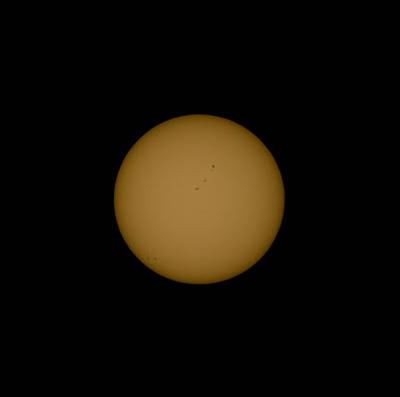
We were pressed for time as the eclipse was almost upon us but the fog and visibility were still very bad. We continued to drive for what seemed like ages without the fog letting up. Finally, 10 minutes prior to the eclipse, the fog cleared up and we found the closest open lot that was allowing for cars to camp and watch the eclipse. I quickly set up my camera on the tripod and got this beautiful shot.

Sun on August 21st 2017. See the amazing sun spots

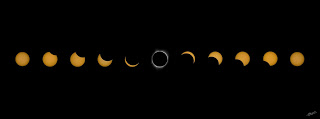
We stayed there for the entire duration of the eclipse and totality was a surreal experience to say the least. It was everything that everyone had described about total solar eclipse and more. I was able to capture this composite.

Our journey back home, well that can be another story in itself 🙂 What normally takes three and half hours took us close to eleven hours as everybody decided that they need to head back home right way. However, this was an experience of a life time! I am looking forward to the next total solar eclipse. I hope we have the means and opportunity to get there.

Astronomy: Low hanging fruit

This post is to help one get some early successes that keep the drive going. One has to understand that astrophotography requires a lot of patience. It can sometimes be very frustrating when we try our best and still don’t get the intended results. However, I believe, that these easy tricks to get your feet wet will help you get wonderful results and anyone with the appreciation for astronomy will then be able to invest the time and effort get those awesome DSO’s (deep sky objects) captured!

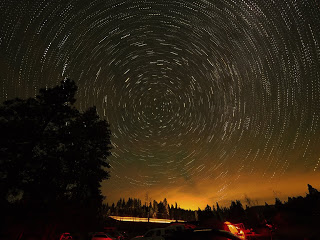
First, let’s discuss a photo of star trails that I took at Brooks Memorial state park. If you don’t already know, owing to the rotation of the earth and its position with respect to earth’s axis, Polaris’ position is relatively fixed in the night sky. This gives photographers opportunity to capture stunning long exposure or stacked pictures of the night sky where star trails appear as concentric circles around the celestial north pole. This picture is easier to take in the northern hemisphere owing to visibility of Polaris which is pretty close to the celestial north. This link shows details of how to identify the celestial North Pole.

While hardly a great picture, the below demonstrates what can be achieved with a simple DSLR, a tripod and some post processing.

Star tails captured at Brooks Memorial State Park

Taking the picture is straight forward. Depending on the ambient light (taking the picture from a dark site is preferable), choose an exposure that is long enough but not so long as to get drowned out by ambient light. Few minute of exposure would be ideal to get long enough trails to have well defined concentric circles. Place the camera pointing towards the celestial north. Ensure you have a wide angle lens to capture a large swath of the sky.

Due to the ambient light from the North, I had to limit my photographs to 30 second exposure. I used a 7mm-14mm lens on my Olympus OM-EM10-Mark II camera set at 8.7mm with f2.8. I took 8 pictures with about 4 minute gap i.e total exposure time of (8*30) 240 seconds. To achieve more definitive concentric circles, I would have needed a lot more pictures or increased the exposure time. I think having about an hour of total exposure (each picture exposure* total number of pictures) or more would result in more definitive star trails.

Once you have the pictures, your work in the field is done. Everything you need to get an amazing star trails picture is through software.