
For a little over a year I have been doing astrophotography from my drive way, I have talked about how there is a lamp post right in front of my house creating challenges in photographing North Eastern Sky. I have, over time, employed crude techniques to limit the light intrusion from that lamp post including a crude cardboard placed on the OTA. Last night I was trying to image the fishhead nebula (IC 1795). It is visible on the north eastern part of the sky and I have been avoiding objects on that side because of the aformentioned reason. However, last night I had a plan! Well, what I thought was a fool proof plan. To block out the light pollution from the lamp post, here is what I did:
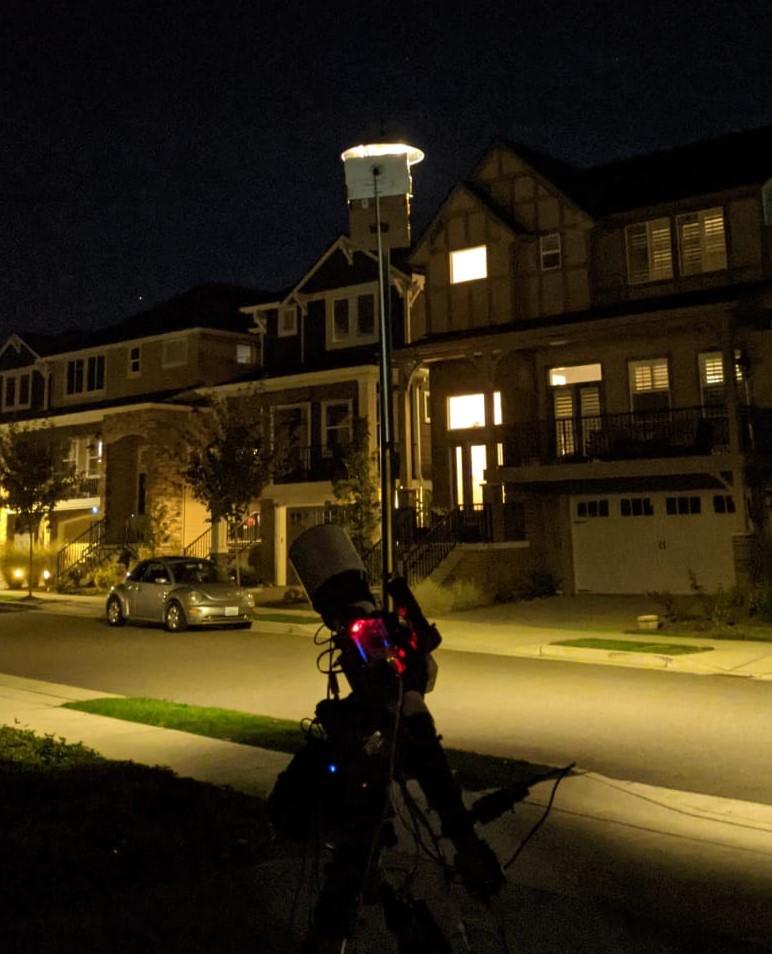
A relatively inexpensive solution that actually did a pretty goood job blocking the light from the lamp post. It’s a bit short and doesn’t cover the entire lamp but that I can fix for next time around. It has now become a part of my setup! However, the night was still mostly a bust for two reasons:
- Full Moon
- Autoguiding
I had accounted for the fact that it was a full moon night and hence deliberately chose a target (away from moon) but the second issue forced me to choose another target. Given that the nebula is faint, I wanted to capture as much data as possible which meant atleast 180 sec, if not 300 sec light frames. Unfortunately, autoguiding was failing due to mount backlash issues. From my prior googling, I know that the mount needs to be balanced and not over capacity. I ensured that th mount was balanced before I started. I need to try next time with one less counter weight placed at the end to see if two counter weights are taking mount over capacity. Anyway, because of spectacular failure in autoguiding, I had to resort to unguided images which meant easier targets. I slewed to triangulum galaxy as I thought it would be okay to get 100 sec or less unguided exposures. While I did achieve good round stars and no star trailing (surprised as autoguiding was failing but this worked 😐 ), there was a glow from the moon that washed up the images. I could not go longer exposures for the fear of getting even more glow from the moon. Unfortunately, that meant no salvagable data from the night and a key learning – there is more astrophotography related spending in my near future 🙂 .
I need to decide what the next steps are. First, I think i need to try out another night to see if guiding issues still persist. If so, it might be time to retire the mount. It’s been with me since 2012 and has fallen from my hand more than once. More on my thoughts on that later. Second, I need to decide between continuing with OSC (one shot color) photography from my driveway, knowing that the lamp post light pollution is potentially solved but moonlight is not, or go with RGB with a monochrome camera. The advantage of OSC is that I get the entire color spectrum data at once. Given that I have limited window each night to work with, I can try to wrap up a target in a couple of nights. However, OSC also means I am limited to nights when the moon isn’t a problem or I have to invest in a LP filter or a nebula boost filter that can block moon light as well. Its a couple hundered bucks and I’m set. I do need to research what filter to buy though 🙂 . Monochrome photography means a whole lot of expenses – Monochrome camera, filterwheel, filters. While it might clearly seem that the scale is tipped towards OSC from cost perspective, monochrome *may* be the way to go if I consider long term where I will invest for my potential (hopefully) future observatory. So … A lot of contemplation, deliberation and reflection lies ahead. Will come back and share my decision and the rationale in the next post. Stay tuned!
 astropilotdad.com