

While visual astronomy provides its own sense of fulfillment, capturing those amazing night sky visuals on a camera provides one with another kind of thrill. However, capturing photographs of the night sky is a whole another ball game and a bunch of investment in time and of course money 🙂
I hadn’t been spending too much time on astronomy/astrophotography and wanted to get back into it so I recently spent a whole lot of moolah in new gear. There were several reasons for my lack of time investment in astronomy/astrophotography : 1) my first telescope, an 8 inch Newtonian, was big and bulky for a quick set up 2) I was still getting my head around polar alignment meaning a whole lot of time spent just in getting the telescope set up 3) Newtonian’s require a lot of upkeep including collimation adding to the set up time 4) Pacific northwest weather did not give many opportunities for clear night skies 5) Life.
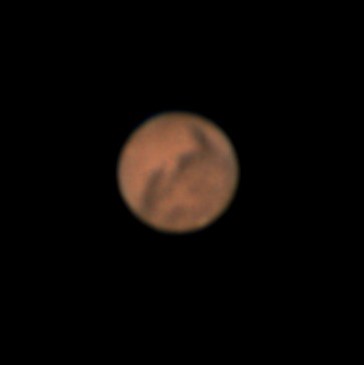
So, the first piece of gear I bought is the Explore Scientific 4 inch refractor telescope. While the scope is half the aperture size of my Newtonian, it is much lighter and bulky so very easy to carry and handle. The second piece was a planetary camera QHY462c and the third one was a 5x barlow. I rushed to purchase the camera and barlow specifically to capture Mars, which was soon going to be in opposition. Armed with the new gear, I set up in my drive way. Unfortunately, the seeing wasn’t as great on the two nights that I set up so extracting good frames was a bit challenge. With the PNW weather, you don’t get many nights in winter where the sky is clear. So those were the only two days where I got a good view of Mars from my drive way. I was able to capture the above image. I think it is not half as bad for a first planetary photograph!
While I am happy I was able to capture this picture, I think for planetary photography, my 8 inch Newtonian is better suited. Over the past several months, I have learnt a lot and I think am now better equipped to take my Newtonian out and quickly setup whenever I need to do planetary imaging. However, that would have to wait for a clear PNW night and planets showing up in the eastern sky to be visible from my driveway.
 astropilotdad.com