

One of challenges for me making progress in getting better at astronomy and astro- photography apart from the fact that I live in Pacific Northwest (PNW) which has way too many cloudy nights, is the fact that back when I bought the telescope, I bought a 8 inch Newtonian which was way too bulky and complex for a newbie. While, I have gotten better and now no longer consider myself a newbie, the bulky equipment was still a challenge setting up, aligning, and collimating on cold PNW nights before actually getting into visual astronomy or astro-photography. In order to make things easier for me, I recently purchased a refractor telescope. It’s a 102mm triplet which corrects for any chromatic aberrations. It’s less than half the length and weight of my Newtonian reflector.

After I got it last week, I was eager to test it out and do visual observing to see how it compares to my old telescope. Since I have a 4.5 month old at home, it’s hard for me to be away for several hours at night so I decided to set it up in one of the rooms with a view of the eastern sky. In the last few weeks Mars is prominently visible in the Eastern sky which seemed like a pretty good target to view. I also got a QHY CCD guide scope and planetary imaging camera that I was interested in testing out. As the night fell, I quickly set up the telescope and tried to view Mars through the 25mm eyepiece. The telescope comes with 2 spacers to be able to adjust the focal length. To get a sharp image, I had to use one of the spacers. When I viewed Mars through it, the planet looked weird. It was as if there was a Bahtinov mask placed on the telescope. See below the picture that I took from my smartphone camera placed in front of the eyepiece.
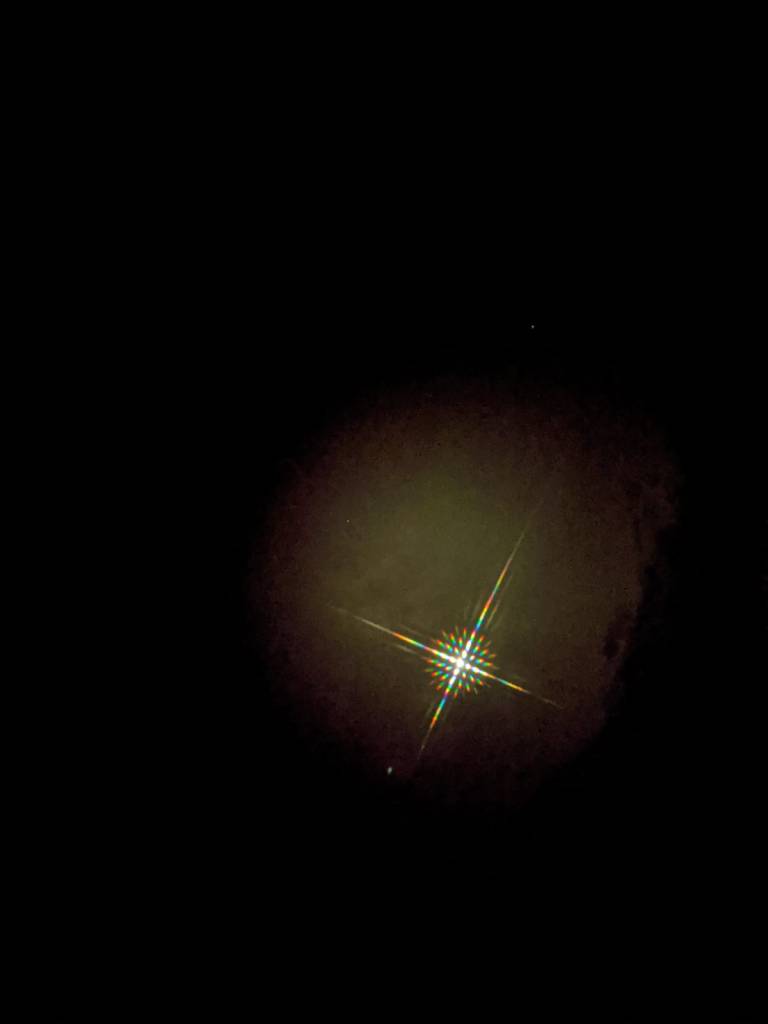
I was concerned and reached out to the customer service to get this resolved. The agent, who was very helpful, thought I might need to collimation to get the lenses aligned. I was very concerned with this given what I read online about collimating a triplet refractor. He assured me that this was not a monumental task if I am familiar with collimating a Newtonian, which I was. I was getting mentally prepared to do collimation but were still exchanging emails about the problem. After some back and forth discussion and exchange of pictures of my set up and telescope, the agent suggested that maybe I should try to take the telescope outside given I was viewing through my window and screen. I thought it might not help but I said I will. I did some online research on effects of window and screen on telescope images. Turns out that temperature differences and screen can have big impact on what we see through the telescope. The screens actually cause a diffraction pattern which result in the image that you see above . Excited that this might be the reason for what I was seeing, I took the telescope out that same night and voila: crystal-clear views of Jupiter and Saturn.
I profusely apologized to the kind agent for sending him on a wild goose chase. Having a recent Master’s in Physics I should have figured that the screen at that distance from the source of light and the telescope was small enough to cause diffraction pattern. However, I was so focused on there being some misalignment on my telescope that I did not even think about it. While classroom learning as all well and good, as they say, experience is the best teacher.
 astropilotdad.com