

This post is to help one get some early successes that keep the drive going. One has to understand that astrophotography requires a lot of patience. It can sometimes be very frustrating when we try our best and still don’t get the intended results. However, I believe, that these easy tricks to get your feet wet will help you get wonderful results and anyone with the appreciation for astronomy will then be able to invest the time and effort get those awesome DSO’s (deep sky objects) captured!
First, let’s discuss a photo of star trails that I took at Brooks Memorial state park. If you don’t already know, owing to the rotation of the earth and its position with respect to earth’s axis, Polaris’ position is relatively fixed in the night sky. This gives photographers opportunity to capture stunning long exposure or stacked pictures of the night sky where star trails appear as concentric circles around the celestial north pole. This picture is easier to take in the northern hemisphere owing to visibility of Polaris which is pretty close to the celestial north. This link shows details of how to identify the celestial North Pole.
While hardly a great picture, the below demonstrates what can be achieved with a simple DSLR, a tripod and some post processing.
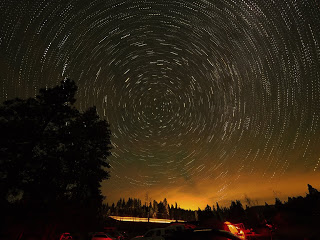
Taking the picture is straight forward. Depending on the ambient light (taking the picture from a dark site is preferable), choose an exposure that is long enough but not so long as to get drowned out by ambient light. Few minute of exposure would be ideal to get long enough trails to have well defined concentric circles. Place the camera pointing towards the celestial north. Ensure you have a wide angle lens to capture a large swath of the sky.
Due to the ambient light from the North, I had to limit my photographs to 30 second exposure. I used a 7mm-14mm lens on my Olympus OM-EM10-Mark II camera set at 8.7mm with f2.8. I took 8 pictures with about 4 minute gap i.e total exposure time of (8*30) 240 seconds. To achieve more definitive concentric circles, I would have needed a lot more pictures or increased the exposure time. I think having about an hour of total exposure (each picture exposure* total number of pictures) or more would result in more definitive star trails.
Once you have the pictures, your work in the field is done. Everything you need to get an amazing star trails picture is through software.
 astropilotdad.com